Before engaging in the exercise for this week, I researched the Positive Psychology website (Houston, 2020) to get an understanding of the various techniques utilized in this specialized approach of interventions. Together with a specialist, individual or group sessions offer ways for clients to be guided into internal states to recognize and promote core values, strengths, and states of positive emotions. The importance of gaining insights from these practices is to indulge clients (or ourselves) in a safe space of complete possibility for a positive future or to accentuate the positive traits that exist amongst adverse environments.
From Barbara Frederickson’s research to broaden and build positive emotions, the effect of increasing positive emotions in one’s life “resulted in cognitive flexibility and openness to experience and help[ed] create a sense of meaning” (Compton & Hoffman, 2013). These exercises offer a way to activate the client with positive emotions, rather than the relentless stream of negative emotions which are typically observed (Houston, 2020). When we engage positive emotions or character strengths in our day to day lives, we expand our well-being and start to experience the “good life” that Positive Psychology embodies.
A study by Pryor, Rush, and Buschor evaluated interventions associated with character strengths that highly correlate with life satisfaction between two experimental and one control group (2013). The character strengths most correlated with life satisfaction are zest, humor, curiosity, hope, and gratitude, to which one experimental group completed various interventions to improve these strengths (Pryor, Rush, & Buschor, 2013). The interventions for curiosity training included four different activities new to the person, while gratitude interventions included writing a letter of gratitude (Pryor, Rush, & Buschor, 2013). The interventions for zest offered physical activities and challenging additions to daily routines (Pryor, Rush, & Buschor, 2013). The action for developing hope as a character strength exercised the idea of one door closes, and one door opens, while developing humor as a character strength utilized an intervention from a humor training program (Pryor, Rush, & Buschor, 2013).
Pryor, Rush, and Buschor (2013) also provided interventions to strengthen the lower correlated character strengths related to life satisfaction. Those strengths were “appreciation of beauty and excellence,” creativity, kindness, love of learning, and open-mindedness (Pryor, Rush, & Buschor, 2013). Before interventions, the participants surveyed their life satisfaction for a pre and post-test analysis. Curiously, the experiences of interventions to lower correlated strengths also improved life satisfaction. Still, the intervention group with the highly correlated strengths showed more improvement in their rating of life satisfaction in the post-test (Pryor, Rush, & Buschor, 2013). The experiment, therefore, is positively supporting the engagement of character strengths to help and offer satisfaction with life, no matter which strength is enhanced.
To increase well-being or life satisfaction, we must increase our ability to flourish, and Martin E.P. Seligman’s Well-being Theory offers five dimensions that he describes in the acronym PERMA (Compton & Hoffman, 2013). [P]Positive emotions to enjoy the pleasures of life, [E]engagement to identify and cultivate signature strengths for everyday activities, (positive) [R]relationships to which all must acknowledge the togetherness of modern living, [M]meaningful life to offer signature strengths towards something more than individual needs, and (positive) [A]accomplishments to achieve and challenge one’s self for mastery and competence (Compton & Hoffman, 2013). The character strengths and their cultivation are, therefore, a huge chunk of positive psychology, as all character strengths can vary per individual. In the variance, each individual can thrive and flourish in any way that piques their efforts so long as they are actively striving towards and achieving PERMA.
A program to develop character strengths serves to broaden personal understanding of self, but also provides useful tools for resiliency to handle future missteps or problems. As a student of psychology, I understand that a personal journey towards understanding the self can be tricky and hard to do on your own, without a guide, so most of us don’t go further into that inner world. Where positive psychology offers a place for individuals to grow through their character strengths, virtues, and positive emotions are by practices and exercises like the one I completed this week, or through the interventions proposed at the beginning of this paper.
The assignment to sit down with oneself can be a challenge for some, but I am seasoned by the years of yoga and meditation I continue to practice. Before engaging with the writing, I listened to a guided meditation for personal development and growth (link in References), and used my character strengths of gratitude and love of learning to envision a lifestyle I will truly honor for myself and my family. The guided meditation helped to slow my mind and close the gap between my thoughts and my feelings. Through the time in meditation, I was able to surrender my body to the sensations in the room completely, and my mind was ready to take the guidance to go within and “see” the life I envision in my future.
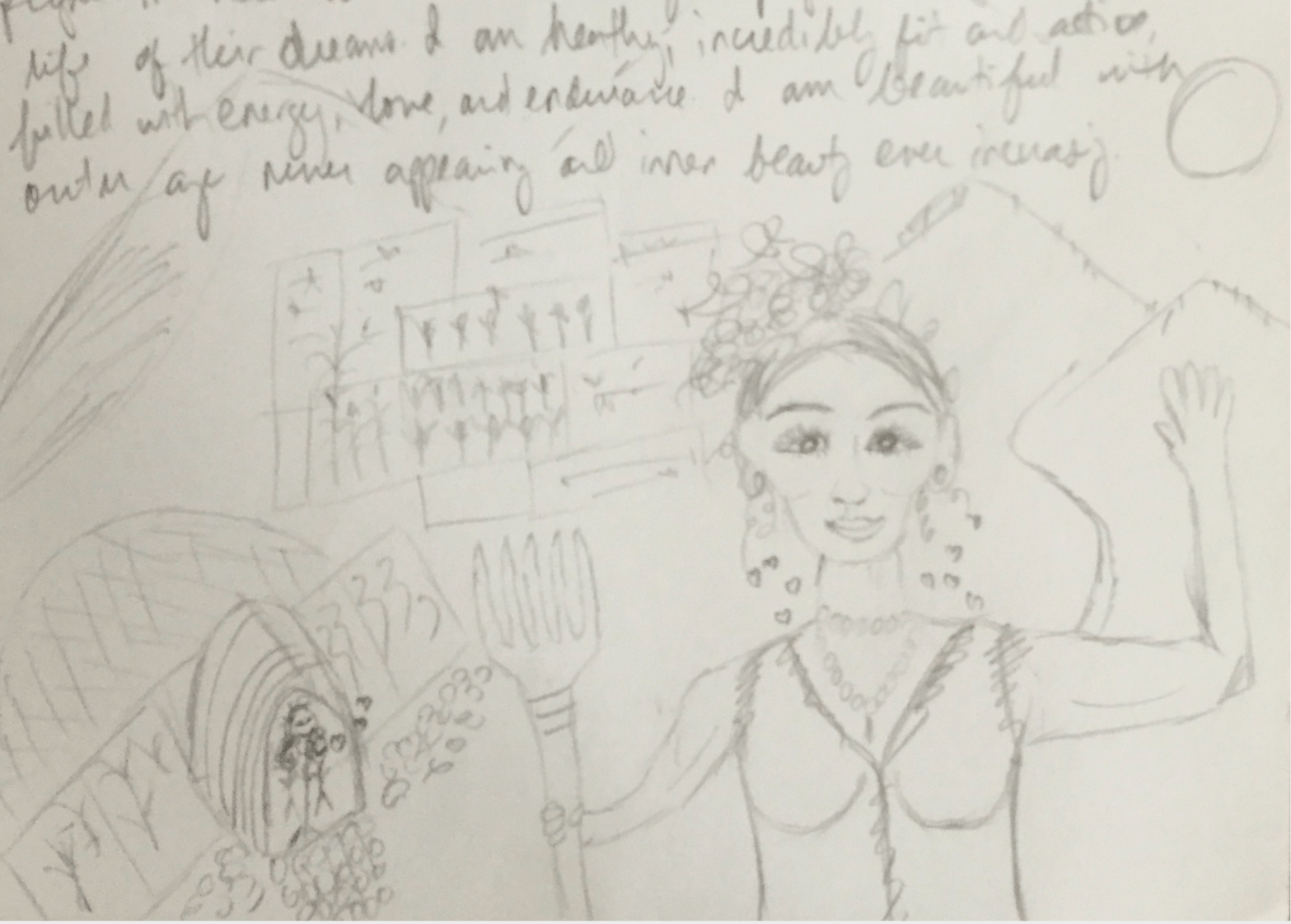
Following the guided meditation, the timer is set for fifteen minutes, and a blank piece of paper started to become filled with goals, ideas of where I will be, how I will act, how I will feel, and what that means for work and travel and family. The ideas poured out of me, and I could have continued to write past the timer. Instead, I used the bottom of the paper to draw the image of myself with the envisioned lifestyle. Following the exercise, rereading the words I quickly wrote caused me to smile and reflect that I genuinely do desire these things in my life, and then an urgency to get to the next step to achieve these things started to press through my mind. Usually, I wouldn’t say that I am emotional, yet I can FEEL something inside that has changed from this exercise. Something pulling me to start actions to get here, and something is saying to me that I can do it.
I have completed tasks like this before, but as I age, I find that I am more engaged with my future through immediate actions. I understand through my experiences that I am in control of myself, the steps I take, and the path I choose. This exercise puts pictures and a narrative as the goal for which my actions should direct. Coincidently, I am also part of a dynamic group that also had an assignment this week to draw a picture of my future achieved self. I had already practiced a little at this exercise.
I find that carrying on without goals or direction is limiting and creates disharmony in my daily actions. Life does not come with an instruction manual, but we can start anytime or anywhere on the path towards a brighter future. The future that is envisioned is achievable. In my opinion, positive psychology will help create the vision for a brighter future through doable exercises and strengthening our connection with character strengths and positive emotions.
References
Compton, W.C., & Hoffman, E. (2013). Positive Psychology: The Science of Happiness and
Flourishing. Independence, KY: Cengage
Fletcher, D. & Sarkar, M. (2016). Mental fortitude training: An evidence-based approach to
developing psychological resilience for sustained success. Journal of Sport Psychology in Action, 7(3), 135-157. DOI 10.1080/21520704.2016.1255496
Houston, E. (2020). 19 Positive Psychology Exercises To Do With Clients or Students. Retrieved
from https://positivepsychology.com/positive-psychology-exercises/#best-possible-self
Proyer, R.T., Ruch, W., & Buschor, C. (2013). Testing strengths-based interventions: A
preliminary study on the effectiveness of a program targeting curiosity, gratitude, hope, humor, and zest for enhancing life satisfaction. J Happiness Study, 14, 275–292. DOI 10.1007/s10902-012-9331-9
“Guided Meditation for Personal Development and Growth” Retrieved from
 Health & Wellness Insights